

Jellyfish Blooms Disrupt Critical Water Intakes and Cause Recurring Downtime.
Get ahead of flow interruptions before they impact your operations.
Coastal facilities worldwide face the same challenge: jellyfish blooms that block intake systems, disrupt operations, increase maintenance costs, and force unplanned shutdowns.

A Growing Operational Risk
Jellyfish blooms are increasing in frequency and intensity worldwide, leading to intake flow disruptions and unplanned operational downtime.
Many coastal facilities still rely on open-sea intake designs that expose critical systems directly to marine biological loads:
- Reduced intake efficiency during bloom events
- Increased maintenance needs and emergency interventions
- Elevated risk of partial or full intake shutdown
- Operators lack effective forecasting tools to anticipate disruptions
The challenge is structural: open intake systems lack a dedicated layer to mitigate biological mass events before they impact operations.
Coastal Water Intake System: Operational Impact Comparison
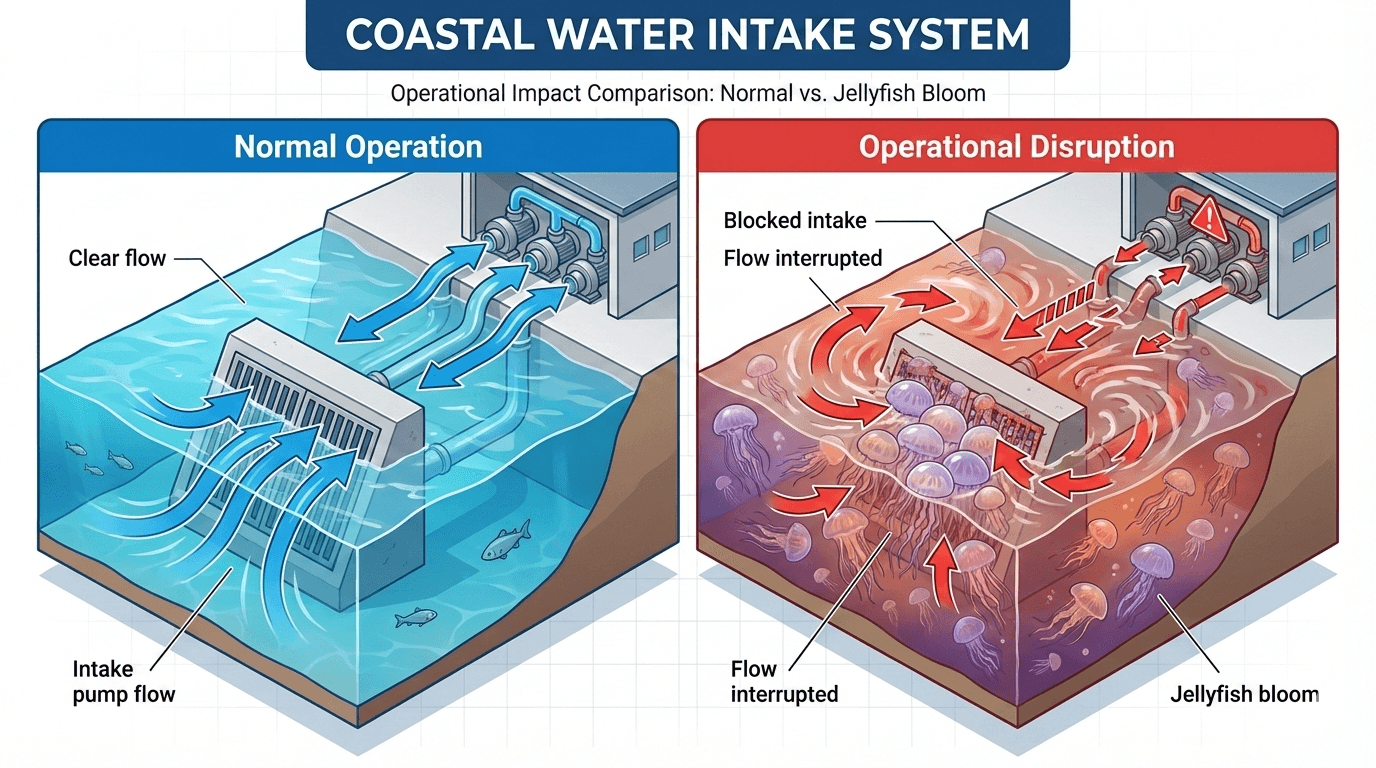
Jellyfish blooms block intake flow and lead to operational disruptions. The diagram above visualizes normal intake flow compared to disrupted conditions.
A Structural Gap Exists in Intake Protection
Jellyfish blooms are becoming more frequent and dense due to environmental changes. Open intake systems lack a dedicated layer to mitigate biological mass events before they impact operations.
The consequences include reduced intake efficiency, increased maintenance needs, and elevated risk of partial or full shutdowns.
JellyGuard addresses this gap with a modular, non-invasive approach that introduces a monitored response layer upstream of seawater intake systems.
How It Works
Upstream awareness and controlled response before disruption
Coastal Intake Monitoring
Continuous observation of intake conditions and environmental patterns upstream of critical infrastructure.
Bloom Recognition and Risk Signals
Identification of recurring biological accumulation patterns associated with intake disruption risk.
Operational Forecasting
Early indication of elevated intake risk to support informed operational readiness.
Actionable Alerts and Decision Support
Clear alerts enabling operators to prepare and respond using existing procedures.
No active intervention is performed at this stage. The system is designed to support anticipation and readiness, not to replace operational control.
Evaluation Indicators
Reduction in intake disruptions
Forecast readiness
Operational stability
These indicators are for comparative pilot evaluation only and do not constitute performance guarantees.
Biomass Handling
Optional data streams may support future biomass utilization. This is not a core system function and does not introduce additional operational complexity.
Ready to Reduce Intake Disruptions?
Ready to reduce intake disruptions and protect your operations? Get started with a free assessment.
JellyGuard is engaging with infrastructure operators, public innovation bodies, and strategic partners interested in pilot exploration and long-term resilience solutions.